
A Man Comes Down - Inst. 20

1. TRAMPLED DOWN FIRST TRY
The name “Trampled Down First Try” is a name I gave to an idea for a novel some years ago. I always really liked the phrase which, because of the fricative “f,” seemed to be more alliterative than its one instance of repeated “t” would indicate. It had a clashing harshness that ended by sounding oddly satisfied, even triumphant. It had an almost mystical appeal for me that outstripped and outlived the fascination of plot itself. I felt it was emblematic of my life in some kind of deep way.
The plot was as follows: A young man about 30 (about the age that I myself was when I had the idea) has a good life but feels himself to be dissatisfied and a fraud, undeserving of the things he has (which I, of course, did not): namely a good job as a teacher, a wife whom he loved, and a beautiful young daughter, less than two. In short, this young man finds himself come to the midst of life, and he fears the peak long before he is ready for it (as if he were the first to feel this way). And although he “knows” he should be happy, and in fact is constantly having to admit to that same happiness under the repeated well-meaning attacks of his friends to whom the auspiciousness of his circumstances is obvious, he does not feel happy. He feels disturbed, and increasingly he thinks of suicide. However, he is profoundly regretful already about all of the grand plans he has failed to achieve—the beautiful ideas he has failed to execute. It was this lack of achievement which is his primary source, his acknowledged source, of pain. That feeling that this was all incredibly beautiful but transient, possibly fading. Every second too obscure. Instead he dwells on his inadequacy in the face of his grand plans for himself and how behind schedule he is.
Again, not uniquely, he rather feels that with all neglected beautiful plans, suicide seems slightly too permanent for his tastes. As an alternative that allows him to continue to work on those plans, he comes up with the idea of faking his own death (perfectly normal, perfectly reasonable!), leaving his former identity behind, and living as a new person in a monastery, perhaps at Vézelay in France. Anyway, he disappears for ten years but then engineers a return narrative for himself and “comes back to life” and to his family.
Likely story! As you might expect, he has some trouble reintegrating with his family. So it didn’t work out the way he anticipated. While in the monastery, he did do a lot of work, but it never came to anything earth-shattering, and in the end he left the material from his work at the monastery. It never came to anything coherent. He has a complicated relationship with his daughter, naturally enough after his abandoning her and then returning.
The least realistic part of my story was that the man is able to salvage a strong relationship with his wife in the end. One should not be able to design the narrative of one’s life with this degree of intentionality. Or perhaps one should, but it seems strange to end as Odysseus on purpose, as it were. Regardless, the second half of the story focuses on the relationship with his daughter and her anger and confusion years later in her 40s. As a professional filmmaker, she decides to make a film about her father’s bizarre life choice. In doing so, she visits the monastery, where she finds the work that her father did while hiding away. The work is amazing and beautiful, coming to it as she is as an outsider. Years later, as a non-creator, she sees an underlying coherence to the work, and she captures this amazing body of rejected work in her film. Thus the main character fails in his project initially in his own generation but later, probably after his death, is fulfilled and vindicated.
Anyway, so much for the plot of this story. As I said, the title invented for it ended up making more of an impact on me. For some reason the phrase seemed resonant to me beyond the limits of the particulars of the plot, as if the name “Trampled Down First Try” described a genre rather than a story. “Oh, such and such has got a ‘Trampled Down First Try’ feel to it.”
Hopefully the connection between the epilogue of “A Man Comes Down” and this other story becomes clear enough. There is also, at least to me, a prescience to it in terms of my own life. Every artist ends up imitating his art with his life if he is not careful—at least it happens. Not that I am comfortable with calling myself an “artist” with so little craft to my name, but you get the picture. Also, “Trampled Down First Try” describes the strange trajectory of this project as well. Naive confidence more than a decade ago that I would create this film in the “normal” way and become a famous filmmaker. It comes to nothing and then life intervenes and then I have a second chance to resurrect the project completely in totally new circumstances (resurrection being one of the major themes of this story anyway). The last note I’ll make without, well, trampling too much on my epilogue, is one about “A Winter’s Tale,” which features here. I encourage you to read it. It’s not the most well-known Shakespeare play, but it’s one I feel connected to and is definitely a “Trampled Down First Try” type of narrative. Anyway, on with the Epilogue!
*Note on Trampled Down First Try*
Narratives that strike me as Trampled type Narratives tend to be those were an element of the set up or innitail part of the story features a set back so devastating that no significant recovery of the heroic role seems possible for the protagonist, yet that very psychological situation allows them to pursue their goals without further fear of failure the worst having already happened. Examples include :Parzival and “the 4 feathers” which I am familiar with as a cheesy historical movie featuring a young heath ledger (it must be good). We are about to look at the Shakespeare play “a winters tale” itself, but such tales are truly appropriate for the winter season because they show characters moving not from darkness to light, but from darkness just to a place where light might be possible again.
2. “A WINTER’S TALE” / BIOGRAPHY
I recommend to anyone who has the time that they watch “A Winter’s Tale” on YouTube. There are at least two versions available. One is a recent American production by a theater called The Swan. I watched the whole thing. It’s presented in the round with a close and fun relationship with the audience. It’s pretty good. There is also an older one by the RSC which is unsurprisingly good. Autolycus is good.
I have an extensive prior relationship with this play. In 2016, I had the good fortune to be a dramaturg for the San Francisco Shakespeare production that year. So I know the text pretty well and I have a warm feeling for it. To be clear however, I absolutely couldn’t, nor wouldn’t, use the text in conversation the way that Ezekiel and Rowena do here. The most I could do is recognize and acknowledge the references as they are being made. Being the writer, however, allows me to play my favorite idiots’ intellectual game. Namely, analysis of one text by spattering in a collage of another. It makes me feel as if I’ve made thematic connections without having to disentangle them all the way.
Anyway, for those who don’t have the time or inclination to watch entire plays, “A Winter’s Tale” is a later play. It’s kind of “Pericles” (a wild and woolly example of the romance genre in the early modern sense) by way of “The Tempest.” Lots of theatrical magic in the conclusion and both anxiety and joy around giving way to the next generation. The connection with the “Trampled Down First Try” narrative lies first, of course, in the destruction of Leontes’ family before it gets rebuilt at the end.
Secondly, and I think more essentially, is the way human agency, or even what one might call contrivance, gets blended with feelings of divine or natural providence. This relates to the slightly unholy-feeling game the protagonist of “Trampled” plays in shaping his own return narrative.
In the play, Paulina’s processes are never explained, which leaves us with the (at least partial) feeling that the alchemy of time—who, lest we forget, is a character in the play—has somehow intervened to naturalize, soften, and bring close to the sacred and providential the hard lines of intentional action.
It seems to me that the degree to which each person permits their own or another’s direct agency to be mingled (as Leontes says, “like mingling bloods”) before it either becomes “too hot” or starts to feel hollow is a matter of personal character. This probably relates to our essential relationship to story and to the extent that we have a residual belief in magic. I know that for myself, I have a relatively low tolerance for the interference of agency, my own or someone else’s, in my essential affairs before things begin to feel giddily unnatural.
(Now clearly, at least in the modern era, you can believe in God if you want—indeed it might be held to be psychologically healthy to do so. But at the same time “He” definitely doesn’t exist, at least we seem pretty sure. So where will you get your providence from, if not from structure that has its origins in humanity?)
Earlier I was saying that I found some resonances between the plot of “Trampled” and my actual life as I’ve lived it. Consider how ridiculous this comment would be if I had actually done many of the things that the character had. (In fact I was asked to leave school as a freshman because I was a danger to myself and yet feel similarly to the character about suicide... But that in itself doesn’t make the overlap great enough that the comment about parallels feels obvious, and not worth saying, to me.)
Another example from my life: as many readers will know, between 2015 and 2019 I engaged in a project that I called “The Living Odyssey,” in which, working intermittently, I attempted to memorize and perform Homer’s “Odyssey.” I ended up memorizing about half the poem in Robert Fagles’ English translation. People would often ask me why I did it—fair enough, I suppose—often with bemusement, sometimes with derision. Although to be fair, the derision never came from people who had seen my performances. Since my aneurysm, it has occurred to me that in my condition now, the project finally makes sense. “Many pains he suffered fighting to save his life and bring his comrades home,” “the man of constant sorrow,” and so on. A more normal, or one could say more “agency-forward,” way of tying together this constellation of life circumstances would be to have an aneurysm, be unable to move or speak, then memorize a long poem about a famously long-suffering hero as therapy. That would make sense to people, not the... reverse. To me, the interconnection only feels real in that I didn’t plan it yet it still makes sense to me on some level. “Real G’s move by accident like lasagna?” Not as good because the sounds in “lasagna” are not accidental, or are they?
I think it’s by stumbling about blindly in this way that my game of text collage, here being played between the texts of stories I tell myself and the events of my life, can feel “legitimate” to me. Can be properly rewarding if these connections come out of the woodwork of my life, as it were.
Even as I search for the kind of “legitimate” providence I find in this coherence by coincidence and symmetry in the overall tapestry when viewed from afar or retrospectively (or lived in reverse like Merlin), what I might call my regular, personal will is trying all the time to get ahead in the game.
If it is the case that uncanny resonances accrue between my writing and my life, then perhaps, if I write an epilogue like this, I will in some way call something similar into being in my own life... Or perhaps it doesn’t work like that? Teach me, Paulina.
“If this be magic, let it be an art lawful as eating...” And so, on with the Epilogue!
3. NOTE ON “A WINTER’S TALE”
“If this be magic, let it be an art lawful as eating.”
What exactly Leontes means by this is a little unclear. However, whatever it is, it feels pretty essential to the strange conclusion of the play—the odd way it sits between sacred revelation and cheap trick. I think that awkwardness is essential to the effect, so I won’t solve anything here. Still, it seems worthwhile to dig into the quote.
It immediately gets a little less confusing when we account for early modern usage. The dizzying trilogy of physical process, art, and magic that hits us initially is reduced somewhat by the fact that the magic is the art referred to.
The next pivot point is “lawful,” which I take to mean less “socially sanctioned” than “natural.” Thus “lawful as eating” refers to the natural, gradual process of transmutation food undergoes after we eat, as it changes into being part of ourselves as life-sustaining energy (before being excreted as waste).
I have, at the moment, a very strong relationship to the wish that processes feel to me as lawful as eating. One thing that the aneurysm did is de-automate many automatic processes. And I often long for the body to take over as it was wont to formerly.
Back in “A Winter’s Tale.” I hate to disappoint Leontes, but this kind of automatic change does not describe bringing back the dead in terms of what he believes is happening here, yet the image is appropriate to the overall feeling of the play, with new life and new generations being born to cover over the pain and morbidity of the prior. In this way, “A Winter’s Tale” resembles an impressionist painting that coheres best if viewed through unfocused eyes. Squint and you see the trick but miss the story. In terms of that trick, what is apparently “actually” going on, eating is important there as well. One of the only hints we get of Paulina’s 16-year plot to keep Hermione alive is the offhand comment by a courtier that Paulina has visited her gallery (presumably to feed Hermione) two or three times a day. “A Winter’s Tale” is complicated and another story. What I meant in using the quote there is straightforward: just as it is natural, a process as lawful as eating, that writers digest their experiences in their work—that they must come out, changed but present—so too I pray will my writing this happy conclusion influence my future experience.
4. EPILOGUE
As we ease our way back into our prior narrative mode...
Narrator: Ezekiel rode to Mission Town, but Rowena had gone by the time he got there. A brief scene of an empty room in Mission Town, bare floorboards in the morning light, an open door with chipped sea green paint on the frame. We can see into a long hallway leading to other simple temporary lodgings. In the cleared room, on the simple unvarnished table, we see only a small calendar, its pages moved by the chill, brisk wind coming through the window that has been left open. Nothing else is visible in the room. The small bed is stripped to the frame. Again we focus on the bare floor with the morning winter light on it, a thin little patch of warmth.
(I like this brief scene. It seems to suggest that this narrator may have seen a slightly different version of the story than we did. One where Ezekiel may have waited longer while his leg recovered before riding to Mission Town, and additionally Rowena may have stayed longer in Mission Town waiting for him. The calendar suggests that, as well as something else that will perhaps be apparent later.)
5. DU HAST?
Rowena is standing again on the quarterdeck of a ship under sail. She looks different. She stands again with her back to us, but her demeanor has changed. She radiates confidence and, indeed, ownership. Physical changes gradually make themselves apparent to us. On Rowena’s head is a broad-brimmed hat. Underneath, her hair is long with a few strands of grey at her temples. As the camera pans in front of her face, we take in the crow’s feet beside her long-sighted eyes. Eight and a half years have passed.
Listen while you read:
There isn’t really a good reason for this one, except that I like it and think it’s funny and know the singer from SDL. There is a dubious sort-of story connection for it though, if you will hear me out: The song is a kind of pun between “hate” and “have” in German. I don’t speak it, but I have a little background from studying when I was younger. Anyway, “du hast mich” could mean either “you have me” or “you hate me.” I think, from my position of relative ignorance, that the lyrics are (in a metal sort of way) playing with the idea that being caught in a romantic relationship can feel as if the other person’s primary motivation is to possess and capture you, which can feel a lot like hate, rather than love. The lyrics build in a compelling way: “du... du hast... Du hast mich... Du hast mich gefragt, und ich hab nichts gesagt.” “You... You have... You have me... You’ve asked me the question (you’ve asked me the question) And I haven’t answered.”
The next part of the song is a kind of parody of wedding vows (with apologies to any German speakers): “Do you want me to be true to you... For all the days? (of your life).” Then a chorus of “No!” Ezekiel never really got the chance to ask Rowena any such question, nor would she have been so unkind in her reply. She never intentionally rejected him. Far from it, she simply had to make a choice whether to move on or not, and she did so. There was, though, a certain amount of this feeling of being trapped and pressurized that undergirded their original fight, and now Rowena appears before us in a powerful, independent, slightly metal incarnation, so the song kind of fits.
The wind swirls around Rowena, taking in the space in front of her beyond the quarterdeck rail. This gives us more time to take in the changes in her appearance. In addition to the broad-brimmed hat with a small dark feather in it (which makes her look a little like Emma) and the new grey in her hair (which was always lighter), Rowena has a new, hip-length leather jacket that is closely tailored to her thin frame—a jacket that is more sharply and personally cut than anything she previously wore. She has on striking earrings: a large orb of lapis lazuli on a string of smaller blue beads, pearls, and black beads leading back towards her ear. In the middle of the orb (on each side) is a circle of jade. Rowena wears both a loose, cotton long shirt and comfortable linen trousers (she looks quite different).
“The cliffs are steep here, Muqin. How are we going to get up?”
A small girl between 7 and 8 with a light caramel complexion and freckles is standing beside her at the rail. She is a rather tall child, if that is indeed her age, with narrow shoulders. She is wearing a simple, possibly homemade, yellow dress. It is simple but the fabric is good. She runs to the side of the ship, giddily looks over the side at the swirling green water, and runs back toward Rowena, nearly slamming into her. “I am not swimming in that,” the girl announces theatrically.
Rowena catches her in a semi-hug, semi-restraint that could remind one of Emma’s gesture holding back James 40 years before on the morning they approached Transformation Rock: “Of course not, silly. Go and ask Michael if the boat is ready.”
The girl runs down the quarterdeck stairs.
We see the bow of the ship churning through the waves, white-tipped on this sunny, windy morning, and come around the point of what used to be called “the hidden bay.” Rowena looks up attentively at the red rock cliffs. The sun dapples them and makes their contours stand out.
Michael is beside her now at the rail, looking out. He is older too. The stubble on his weather-beaten face is grey. The seams of his big face form a smile—
“It’s good to finally have you on one of these trips, Rowena. It’s felt strange carrying your goods back here, not having you with them... The boat is ready.”
“I had to wait for the business to get strong enough to stand on its own before I could come... And there were other factors too...” she says, watching the young girl run excitedly back and forth as the boat is lowered.
“Of course. It’s been good to have you in any case... Shall we go down?”
5. THE LADDER
Rowena, closely followed by the girl, descends the side of the ship into the lowered boat. The ladder swings with the current and the wind, but the girl clings on gamely.
From above, still on deck, Michael calls down—
“I’m sorry I can’t go with you. We’re all official business this time, and I’ve got to be ready for the unloading at Baywater today. But you’ll be alright? You’ll make your own way there? We’ll pick you up tomorrow, then!”
“Yes, Michael. Thank you for doing this. I’ll be fine. It will give me a chance to see the place again.”
Rowena makes a space beside her in the boat and looks up at the sailor—the coxswain of the smaller boat. He has been with the crew a long time, since Rowena left the coast. In fact, he is the same sailor who acted as Michael’s lieutenant on the occasion of his taking Rowena from here all those years ago: a rather pugnacious-looking man though pleasant to talk to, rather small, brown-bearded, with bright, beady eyes and a wizened, weathered face. With his big soft black leather boots and an oversized pistol jammed in his belt, he looks a little like a swashbuckling gnome.
Sitting close to him in the narrow boat, she addresses him:
“Who is your agent on shore now?”
He shrugs. “It isn’t like it used to be. Some farmer or shepherd I think. We don’t use the system with the light anymore. He—whoever he is—doesn’t really have anything to do with us directly at all. He just drops a ladder in when we need to come ashore properly and keeps to himself. Look, it’s there now…”
Indeed, above the stony secluded beach hangs a rope ladder, its shadow against the cliff in the sun more visible than the rope of its actual rungs.
The boat runs into the white water and stops. The sailors reverse direction, and four of them get out and actually push the boat back through the churn of broken waves. The gnomish coxswain is one of those who shifts himself, hopping out while nodding to Rowena to indicate she should get out as well. Without ceremony, the little man effortlessly picks up the girl to effect her transfer. In the ankle-deep shallows, he sets her down and says to Rowena:
“Well, we’ll see you in Baywater then. If you are detained for any reason, we can pass by here in two days, but it won’t be easy to pick you up.”
To the girl, as he turns back to the task of shifting the boat: “Alright, goodbye, lass.”
A plane of intense, reflected sunlight seems to absorb his face and cut him off from conversation prematurely.
Out on the pebbly beach, Rowena collects herself to begin climbing the ladder. The girl is distracted by many subtly varied shapes and colors of the smooth pebbles—which she gathers in her hands, letting them slowly slip out to trail behind her, like a girl in a fairytale.
The two of them climb up the ladder in the wind. The girl goes first for safety.
“You can’t climb with your hands full of rocks! Empty your hands!”
Reaching the top, the girl feels as though transported to a new world of sandy soil and long summer grasses. She hesitates on the edge of the track she finds there. When Rowena comes up, she takes her hand and follows her forward.
6. A WALK IN THE WOODS
Rowena and the girl walk hand-in-hand up the hill towards where Rowena’s house used to be. There is summer grass in what was the yard. Now the yard is divided in two, such that half of it is a pen for goats. The half of the yard to the north of the door, running to the stream, has been fenced off. Inside this space is a new carriage shed in which someone is working.
Outside the gate, near where she is, a large gray horse—Morning Smoke himself—is grazing outside the gate, much as he was when she first met Ezekiel.
“Horse!” says the girl.
Rowena leads her up to greet Morning, who extends his muzzle down, even paler with age.
“This is Morning. We know each other.”
Rowena notices that someone has made elaborate wood carvings flanking the gate. At that moment, Ezekiel comes out of the shed. He comes round the corner, pushing the cart. He is mostly unchanged—only his springy hair has grey in it, and in the hand that doesn’t push the cart he holds a carved cane which he uses for walking, the bone from his leg never having set properly.
He immediately recognizes Rowena and is stunned. Retiring a moment into the house to put away his work equipment and cover his confusion, he returns.
They stare at one another.
After a moment, Rowena says with a cracked smile, “Do you live here? Alone?”
“I do. You can stay here for a few days if you need to.”
Having mirrored their first interaction, they smile at one another.
Ezekiel notices the little girl in the yellow dress properly: her freckles, the unabashed toothy smile she shared with Morning, the serious, watchful way she is looking at him now. She feels his eyes on her.
“This is Perdita.”
“Perdita…” (rather awkwardly) “Hello, Perdita. How old are you?”
“I’m 8!”
“Nearly 8,” corrects Rowena.
There is a pause.
“I see you have the goats now… Well, at least you have some goats.”
“I suppose they are probably the same goats. I got to know your grandmother-in-law quite well. These were her goats. She died about three years ago. I’m not sure how it came about really, but I ended up visiting her a lot during her infirmity. She taught me to make cheeses, and I took over her business and her goats at the end. In fact, just now I was about to take the cart into Baywater—would you like to come with me, ladies?”
“Yes, that would be good for us. Our ship will come in there.”
Together they haul the cart to the gate and get Morning—reluctant and incensed by his new role—into the traces.
As they are doing this, Rowena glimpses a black horse tied up at the fence in the trees behind the house.
“Come along,” Ezekiel says, guiding the cart and the dubious Morning onto the track, headed north.
“I don’t know that I can stay,” says Rowena. “The people I’m with can’t wait.”
Ezekiel, after a moment: “Perdita. From A Winter’s Tale. Remember at the beginning of the play how there is the whole conflict about Polixenes staying or not? I could say—‘You shall not go!’”
Rowena: “But then, speaking as Hermione, I would say, ‘Methinks you do charge him too coldly… In wanting to see his son again, he has a powerful reason.’”
Ezekiel (laughing, covering emotion): “Now we are surely becoming confused…”
Listen while you read:
“Well, life is complicated,” says Rowena. “And anyway, how can you be so sure that the ‘stay’ argument is yours after all?”
“Well, but it is. And has always been, truly!”
“‘Truly,’ a woman’s ‘truly’ is as powerful as a man’s!”
They are caught between irony and humor, acting and revisiting real emotion.
7. OLIVES AND MEMORIES
Listen while you read:
Ezekiel prepares a picnic by the roadside. Out of the cart, he pulls a blanket for the three of them to sit on. They are sitting on a high bluff overlooking Transformation Rock, although none of them remark on it. The afternoon sun is intense, and Ezekiel positions them in the aromatic shade of some gnarled and stunted bay trees.
He distributes thick sliced bread, carefully wrapped goat’s cheese, and olives bathed in olive oil.
“One of the privileges of being able to live around here for years: I get these from a lady in town to sell with the cheese I now sell at the weekly market. Here, try them.”
Perdita bites into one and recoils.
“It’s horrible! Why would you eat something like that?!”
“Well, I like them. You don’t have to eat them.”
“No, they are horrible in a strange way that makes you want more!”
Rowena laughs.
Rowena, sitting close to Ezekiel, draws her knees under herself.
“What happened to your leg?”
After Perdita runs off to explore, Ezekiel answers.
(He recounts the Court Gang, Nat’s arrival, the firefight, the shattered bone.)
“I felt the same thing,” says Rowena. “I feared you might have had to kill him.”
“He was your husband…”
“He was your friend…”
Ezekiel quotes The Winter’s Tale.
They wander into the shade. Rowena returns to the light.
“You’re giving me a seizure,” Ezekiel says flatly.
Down the way, Perdita waits.
“Can she really be mine?” whispers Ezekiel.
“‘You cannot choose but branch now,’” whispers Rowena.
8. TO THE MAGICIAN
Perdita walks the rocky shore collecting shells, driftwood, and a large live snail. She places it carefully in a patch of green grass.
Back under the bay trees, Ezekiel studies Rowena’s face.
“Hermione was nothing so wrinkled as this is,” Rowena laughs.
Ezekiel drops a stone into the sea.
Rowena sits up. Perdita is returning.
“There is a magician at the market,” Ezekiel says. “If we hurry, we can see him.”
With a sigh, Morning moves forward. The cart trundles north along the cliff.

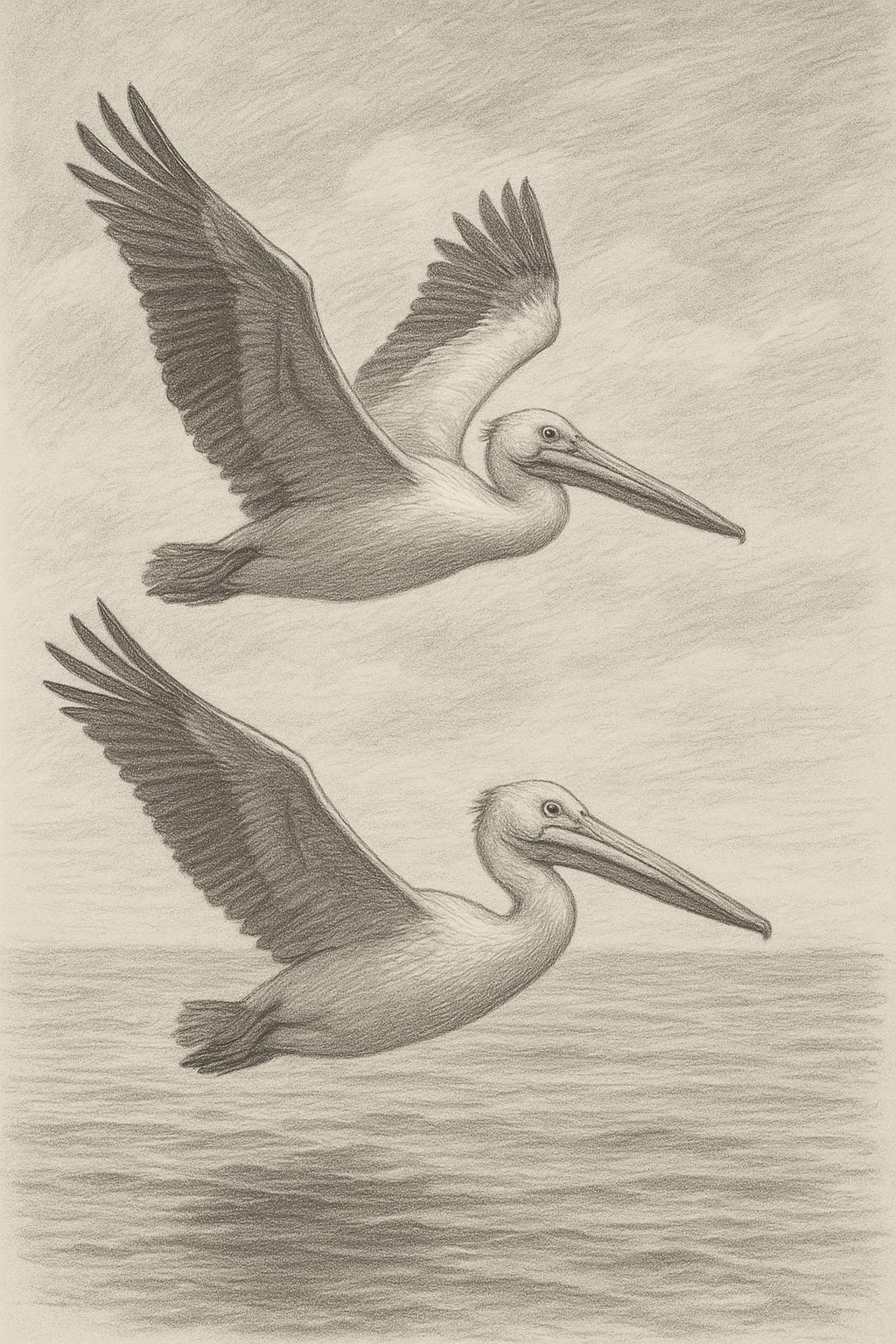
Pelicans cross the bay.
“Go together you precious winners all—”
“Be merry, my friends, be merry
the treasure we seek is buried,
but don’t you weep, dig the shovels deep...”
Fin.
9. END NOTE ON THE TITLE
As I said at the outset, the title comes from the original first line. In the original conception, Ezekiel didn’t have a name, but was simply “The Man.” In the first line he remains indefinite, “a” man. In terms of additional metaphorical valences there is beside the ways that descent can become metaphorical: morally etc., the idea of reduction and the way we say that something “comes down to” something or is essentialized to something. Personally, I kind of combine these to translate “comes down” to mean something like, “at last manifest.” There is an element of mournful reduction. After all, before you “came down” the possibilities were infinite. But primarily, there is a feeling of achievement or settling. A realization that whatever your flaws, you are now something which is infinitely different to being nothing. And, all in all, you’ll take that.
... As for this project, it certainly feels very different to have, to the best of my ability, completed this first phase instead of it merely existing in potential. “A Man Comes Down” comes down, as it were. It’s a beginning only. I’d like to find an artist interested in illustrating it next!
But the completion of this phase is worth celebrating, I think! It being almost Thanksgiving, it feels appropriate that I thank my family for making this possible, despite it making their impossible task of caring for me frequently more difficult and complicated. I very much could not have done this without you! Thank you to my current caregivers, Karen and Asha, and a special thanks to Ray, my friend and former unbelievable care giver, who still publishes these installments even though he is busy with his own life. I would like to thank Stan Okumura who has been a true supporter of “A Man Comes Down” from the beginning, all those years ago. Sometimes being a necessary voice of realism during my years of failing to finish anything close to a first draft, which definitely helped keep me committed to reaching this day. I also can’t overstate the value of your unfailing support and positivity since my aneurysm. Thank you, Stan! Lastly, I of course wish to thank my friend Josh Windmiller, who, for those of you who don’t know, is the model for the character of George, the itinerant musician. I like to think he somewhat resembles the character of Snuffkin from the Mumin troll children’s books. He was always one of my favorite characters. Josh has been an unflagging nursemaid, if such I can call him, in every way these 2 years and more! He has been a reader, an editor, an advisor. I’d call him a coauthor, except he is a writer himself and I don’t want to muddy his hands over much. He has his own sensibility and he worked very hard to honor my vision. Still you can do these things, and still be a cowriter - and so he is! Thank you, Josh! Thank you my friend! Thank you for reading everyone, and for supporting me. Happy Thanksgiving!
What a fun read! (And thanks for the shout-out! Truly honored.)
Celebrating You!